Tag Archives: New York City government

Charter Revision Commission Announces April Public Hearing Schedule

The New York City Charter Revision Commission has issued its schedule of public hearings for April, 2010. One hearing is scheduled in each borough.
The first hearing will be held on Tuesday, April 6, at the CUNY Graduate Center, 365 Fifth Avenue, in the Proshansky Auditorium. This hearing, like all the others except for a 4 p.m. hearing in Brooklyn on April 20th, is scheduled to start at 6 p.m.

The full public hearing calendar can be found here.

Charter Revision Commission Executive Director to be Named (Updated 4/7/10)

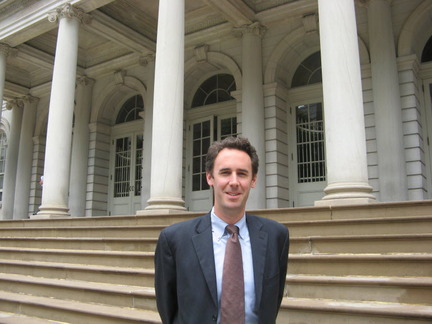
Francis Barry, Charter Commission Executive Director Candidate. Photo courtesy Staten Island Advance

Once again, the Staten Island Advance provides early coverage of events at the NYC Charter Revision Commission. This time, it’s who is likely to be appointed to direct the commission’s staff: Francis S. Barry, a close mayoral aide.

As we’ve commented before, the commission’s executive director is the key person in shaping the commission’s agenda, triaging what information gets in to the 15 part-time commission members, and, perhaps most crucially, determining what information gets out from the commission to the press and the public. Continue reading

Community Boards Threatened

Image: Madison Area Technical College

Less than a year ago, Mayor Michael R. Bloomberg announced that “civic service may be the most important thing we ever do” as he launched his “NYC Service” initiative to promote volunteerism and “channel New Yorkers’ good intentions to tackle our greatest challenges, particularly those caused by the economic downturn.”

Today, he violated that commitment by authorizing a devastating budget cut to NYC’s community boards, whose almost 3,000 members constitute the city’s largest cadre of civic volunteers.

In an email to the city’s 59 boards, mayoral budget official Randolph R. Panetta announced that budget director Mark Page had ordered each community board’s budget cut by $15,542 — a droplet in the huge bucket that is the city’s $4.9 billion Fiscal Year 2011 budget shortfall, but a cut so severe at the local level that many boards will have to reduce staffs that already number only two or three employees. Continue reading

NYC’s Forgotten Borough

To most Manhattanites, Staten Island may as well be New Jersey (geographers and Staten Islanders feel the same way). Once you step off the ferry at St. George Terminal, you’re in a different world: a revolutionary war fort, mile after mile of low-rise garden apartments, Victorian frame houses on winding streets, and wooded hillsides studded with stone and brick mansions.

New Yorkers who view Staten Island only from the S.I. Expressway and the West Shore Expressway don’t see the island’s vast industrial tracts on one shore, its beautiful public beach on another, the endless strip mall that is Hylan Boulevard, and the island’s golf courses, forests, and pre-Verrazano enclaves, which still hint at their rural origins. It just ain’t the same city as high-rise Manhattan.

That’s the message that Tom Wrobleski, political editor for the Staten Island Advance, sends to the 2010 NYC Charter Revision Commission. With just one Islander on the 15-member commission, Wrobelski doubts that Staten Island’s small-town distinctiveness can be adequately considered when the commission revises NYC’s government this year. To Wrobleski, the city’s rules in Manhattan and Staten Island need to be different. And many community leaders from Brooklyn and Queens feel the same way about their own boroughs. Continue reading

Charter Commission Kick-off: Cheesecake and Undercurrents

First came the cheesecake: Brooklyn BP Marty Markowitz greeted the 2010 NYC Charter Revision Commission members at their first public meeting, at the NYC College of Technology in downtown Brooklyn, and gifted each one with Junior’s cheesecake.

Then commission chair Matthew Goldstein explained the purpose of the meeting to an audience of about 75, and invited his colleagues to introduce themselves. When the intros progressed across the crowded stage to commission member Carlo Scissura, Scissura leaned back and deferred to colleague Hope Cohen, who had been forced to sit behind him when the dais got too crowded for all 15 commission members. Goldstein, a mathematician by training, joked about this as being an example of “a packing problem.” It was not his last mathematical allusion. Our take: The commission’s March 3rd appointment date didn’t leave enough time to hire the staff members who could prepare for a public meeting scheduled only two weeks later. Continue reading

Government 311: How to Improve Complaint Submission

It’s not the first time that 311 has been used to harass neighbors, but it may be the most egregious. Jim Dwyer, writing in the Metropolitan Section of Sunday’s NY Times, tells of a rash of phony 311 complaints that, Dwyer says, “has put thousands of homeowners in Queens under a state of bureaucratic siege.”

“From September to December, more than 3,000 complaints of illegal [residential] conversions were filed in three Queens neighborhoods — Whitestone, Flushing, and Malba.” The result: Buildings department inspectors repeatedly seeking entry into homes maliciously identified by anonymous complainants. Continue reading

The Bloomberg/Citizens Union Charter Agenda

Mayor Bloomberg’s 2010 charter revision partnership with the Citizens Union showed its face Monday in the form of a comprehensive charter overview by CU panelist Douglas Muzzio, a professor at Baruch College. Here’s some of what Muzzio wrote, with our translations in italics:

Describing the current city charter, Muzzio called it “a large document (currently 356 pages), packed with organizational minutiae, much of which belongs in the Administrative Code.” The Bloomberg commission — with the help of the Citizens Union — will call for “streamlining” the charter by shifting some of its provisions to the Administrative Code. This will make it easier for the mayor and the Council to change those provisions later on, without the public scrutiny that would occur if they remained in the charter.

Continue reading

Government 101, Lesson 1: Why Can’t the Streets Be Smoother?

Sometimes, the best ideas come while driving in heavy traffic. Although we don’t talk or text while behind the wheel, we do tend to obsess about city government. We also do that in other inappropriate situations.

Our latest episode happened while driving up Brooklyn’s Coney Island Avenue. Our tires kept on banging into one manhole depression after another. The 5-minute ride felt as if we were on an IED-pocked road in Afghanistan, not a major thoroughfare in America’s largest and most vibrant city. “Why can’t the city even pave the streets right?” we asked.

But, of course, we already knew the answer: Coney Island Avenue had been paved by a low-bid contractor, working under the oversight of private engineering consultants. They, in turn, had been supervised by civil servants who may have lacked the tools to impose useful sanctions if either the consultant or the contractor screwed up. Could efficiency improvements — which Mayor Bloomberg’s 2010 charter revision commission may try to implement — solve this? Continue reading

Pressure Builds for November Charter Revision

James Brennan

Mayor Bloomberg’s rumored charter revision commission is under the gun to get its proposal(s) on the ballot before New York State alters existing charter revision rules.

The New York State Assembly Standing Committee on Cities, chaired by James Brennan (44AD, Brooklyn), just announced a public hearing to be held on February 17 to consider changes in the way city charters can be modified. Brennan’s committee has been considering legislation “that would change the composition of charter revision commissions and legislation that would repeal the provision that prevents citizen initiated ballot questions if a charter revision commission has been convened.”

To avoid any changes that the Assembly might try to enact, the mayor’s charter revision commission would have to meet a schedule for an Election Day ballot this November.

More on the relationship between New York City and New York State here.