Tag Archives: Michael Bloomberg

How to Restructure City Government

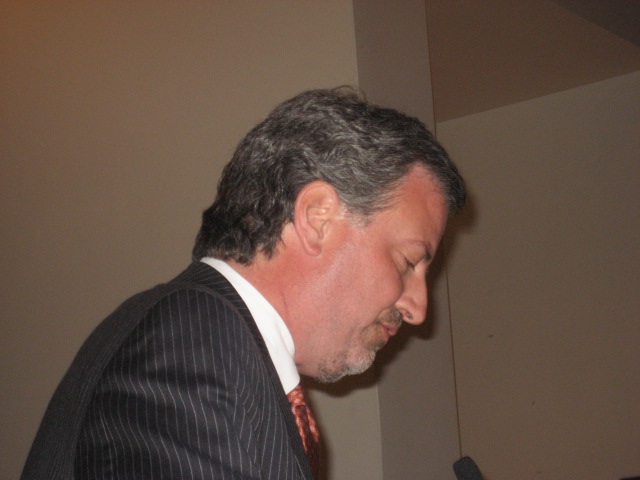
Public Advocate Bill de Blasio

Does it really make sense to cast separate ballots for a mayor and the official who succeeds him in event of mayoral disability (right now, the public advocate)? Or should the charter be revised so voters can cast a single ballot for a team, as they do for President and Vice-President, or for New York State’s governor and lieutenant governor?

One female Democratic district leader in Brooklyn who asked to remain unidentified thinks the team idea makes sense: “Two peas in a pod works fine for 60 days. Right now, it’s the public advocate until the special election, and if he doesn’t know what’s going on with the mayor, you have chaos.” Continue reading

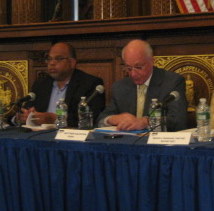
Charter Revision: Speaking Truth to Power

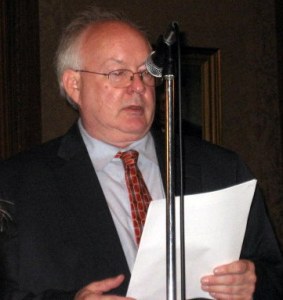
Father Richard Gorman

It took four hours until anyone — expert witnesses, charter commission members, or one of the evening’s 21 informal speakers — finally zeroed in on why voter participation has plummeted in NYC over the last two decades:

“Maybe the reason why people don’t vote is they don’t think it’s worth the trouble of going to vote for a government that increasingly shuts them out.”

The speaker was Father Richard Gorman, chairman of Community Board 12 in The Bronx. Unfortunately, by the time he spoke, at 10:05 PM, the panelists, half the commissioners, and almost all the main-stream press, had deserted the Lehman College auditorium. The few audience members who lingered were mayoral aides or one-issue advocates for non-partisan elections. Continue reading

Voter Participation Takes the Spotlight

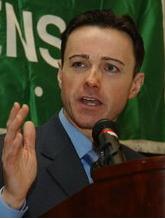
John Banks and Matthew Goldstein

This week’s charter revision commission forum on Voter Participation will take place at Lehman College in The Bronx at 6:00 PM on Wednesday, June 2. With live webcasting in place, it’s a fair bet that relatively few residents of Brooklyn or Staten Island will make the journey to personally attend —- except for members of the Independence Party and its youth affiliate, the All Stars Project.

The Independence Party — now New York State’s third largest — perennially pushes for non-partisan elections: a voting change that in NYC would weaken the dominant Democratic Party and make it easier for well-funded media campaigns to trump grass-roots voter organizing at the polls. Continue reading

Charter Revision Focuses on Term Limits

John Keefe

To jaded journalists, Tuesday’s charter revision commission forum on term limits provided a stimulating, wonkishly entertaining, and ultimately inconsequential diversion. One observer sitting in the second row at Brooklyn’s Borough Hall chuckled throughout.

To John Keefe, who spoke for Brooklyn Assemblyman James Brennan, the forum — and the commission itself — were “part of a cynical and opportunistic deal” that Mike Bloomberg had made in October, 2008 with billionaire term limits advocate Ron Lauder as the price for Lauder’s non-opposition to Bloomberg’s run for a third term as mayor. Continue reading

Term Limits and Non-partisan Elections

The 2010 charter revision commission’s upcoming Tuesday evening “issues forum” on term limits is just a detour on Mike Bloomberg’s path towards increased political power for members of the Billionaires Club.

The real thrust will play out the following week, when Bloomberg’s commission discusses non-partisan elections. Why are those so important to billionaires?

Joseph J. Savino, the Bronx Republican chairman, answered this for Sam Roberts of the NY Times: Non-partisan elections eliminate the need for party primaries, thus robbing the parties of a major raison d’etre. To Savino, as well as to most Democratic Party leaders, political parties are the only way to counter great personal wealth. Roberts writes:

“Mr. Savino said the party organization was “what separates the ability of an everyday person who doesn’t have a billion dollars to get on the ballot.”

“’If you’re just Joe Citizen,’ he said, ‘you need an organization.’”

Charter Revision Alumni Weigh In

F. A. O. Schwarz, Jr. photo courtesy praxagora.com

You wouldn’t expect that a panel discussion by former charter revision commission chairs would be enlightening or amusing, but it was both. Monday’s webcast panel at Baruch College featured former commission chairs Richard Ravitch (1986-88), F.A.O. Schwarz, Jr. (1989), Randy Mastro ( 1999, 2001), Frank Macchiarola (2003), and Ester Fuchs (2005). Current commission chair Matthew Goldstein moderated; several of his colleagues participated in the questioning.

The senior panelists agreed that Mayor Bloomberg’s 2010 commission has no choice but to address term limits (although they couldn’t agree on how), that New York’s strong mayoralty must continue, and that the borough presidents’ offices should be strengthened. What they didn’t agree on — term limits, their impact on minority voting, the fate of the public advocate, and non-partisan elections — provided some lively back-and-forth. Continue reading

311: A Political Tool

The News and the Post report that Mayor Michael Bloomberg suggested to parishioners at Brooklyn’s Christian Cultural Center that they should use 311 to help them lobby to raise the state’s charter school cap. “Just pick up the phone, call 311, ask for the name and the phone number of your state senator or state assemblyman, call them up and say, ‘This is an outrage!'”

Strictly speaking, anyone can call 311 to learn an elected official’s phone number. But the mayor’s suggestion that 311 should be used in support of a specific political initiative — one that he favors — skirts the edge of propriety — and, maybe, the law. Continue reading

Charter Revision: Just Like Jury Duty

Stephen J. Fiala

One surprise from Monday morning’s webcast meeting of the 2010 NYC Charter Revision Commission at the Tweed Courthouse was that Staten Island commission member Stephen J. Fiala emerged as a hard-liner with respect to the commission’s tight schedule. Here’s what happened:

Chairman Matthew Goldstein asked executive director Lorna Goodman to describe the five “issues forums” that the commission will convene starting later this month. These, she said, will center on land use; term limits, voter participation, including consideration of non-partisan elections; “balance of powers,” including the roles of the borough presidents and the community boards; and fiscal integrity.

Goldstein then turned to Fiala to read the resolution by which the commission would formally adopt the commission’s calendar, including another round of public hearings to be held during the summer. After those, he said, the commission will have to make a “pivotal decision” prior to September 2 as to  “whether to cull a subset of issues” to be presented on November’s ballot. Continue reading

Community Board Budgets to be Restored

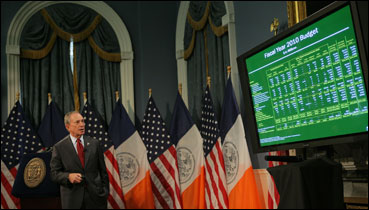
Mayor Bloomberg’s Fiscal Year 2011 Executive Budget calls for the restoration of community board funding to $198,895.

The restoration comes after almost $60,000 in reductions proposed by the mayor’s Office of Management and Budget earlier this year.

Those proposed reductions prompted many community board members to argue for “baseline budgeting” at April’s charter revision commission public hearings. Many boards also reached out for help to their borough presidents and City Council members. Continue reading

Stephen Goldsmith: What to Expect?

Stephen Goldsmith

Unlike some previous Bloomberg appointees, Stephen Goldsmith, Bloomberg’s newly-announced deputy mayor and chief operating officer, comes with a well-documented track record one that won’t necessarily please NYC’s municipal unions.

Goldsmith’s appointment last week drew the attention of several media outlets in Indianapolis, where he served as mayor between 1992 and 1999. There, he earned a reputation for privatizing city services and cutting costs, which he parlayed into a senior domestic policy advisor’s position with George W. Bush’s campaign. Among the services delivered by private companies during Goldsmith’s Indianapolis stint were the city’s car-towing operations, golf courses, sewer-bill collections, and document copying. Continue reading