Mayor Finally Names 2010 Charter Revision Commission

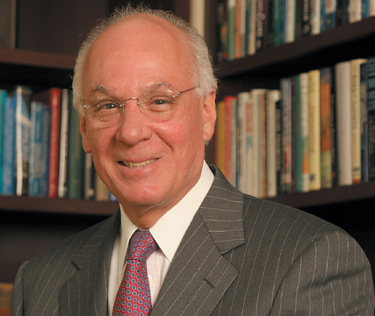
Matthew Goldstein

Mayor Michael R. Bloomberg finally named CUNY Chancellor Matthew Goldstein to chair his 2010 charter revision commission. Along with Goldstein, the mayor’s press release identified 14 other commission members.

Two of them can be expected to be particularly sensitive to the interests of NYC’s community boards: Anthony Perez Cassino, an attorney who served as Chairman of Bronx Community Board 8 from 2004-2008, and Carlo Scissura, who currently serves as Chief of Staff to Brooklyn Borough President Marty Markowitz. Continue reading

Government 101, Lesson 2: Why Does NYC Have So Many Traffic Lights?

Well, actually, only about 12,000 of NYC’s 43,000 intersections are “signalized.” The borough with the most traffic lights is Brooklyn, with over 4,000. One report has it that the first red-green light in NYC was installed in 1930.

By the Giuliani administration, the numbers were in the thousands, and the city’s Department of Transportation needed 34 months to evaluate whether an intersection needed one. Giuliani saw the lights as an easy way to curry favor with constituents, so he instructed Transportation Commissioner Christopher Lynn to eliminate a 600-light backlog and cut the study time. Lynn reduced the study time to 12 weeks. During his regime, the number of traffic lights installed went from 56 in 1995 to 169 in 1996, and to a a planned 222 in the first five months of 1997. By early 1997, the city’s traffic lights totaled 10,687. By January, 2006, after Michael Bloomberg had been in office for four years, the number had increased to 11,871. Continue reading

Charter Revision: No Lauder?

Elizabeth Benjamin reports that billionaire businessman Ron Lauder, principal sponsor of the 1990s referendums that restricted NYC elected officials to two 4-year terms, has declined to serve on Mayor Michael Bloomberg’s anticipated 2010 charter revision commission. If confirmed, Lauder’s withdrawal may mean that he expects the Bloomberg commission to seek to ratify last year’s City Council legislation that extended the limits to three consecutive terms—or maybe even to try to eliminate term limits entirely.

Charter Schools Chief Tells It (sort of) Like It Is

Michael Duffy photo: the Lo-Down

In a revealing interview with NYC Department of Education charter schools head Michael Duffy, Ed Litvak of the Lower East Side news blog The Lo-Down questions Duffy about how the NYCDOE used a recent public hearing on the proposed expansion of a Lower East Side charter school. Duffy’s response won’t surprise anyone who has sat through a charter school hearing:

“It definitely provides a forum for people to speak out, and I think that’s a good thing. It helps to get good information out there… I think, for my part, in a couple of hours of comments, I didn’t hear anything new from the public that wasn’t already known prior to the start of the hearing. I know it’s important that people have a chance to speak their mind, but I don’t think there’s anything that wasn’t known to the Department prior to the proposal…” Continue reading

Government 101, Lesson 1: Why Can’t the Streets Be Smoother?

Sometimes, the best ideas come while driving in heavy traffic. Although we don’t talk or text while behind the wheel, we do tend to obsess about city government. We also do that in other inappropriate situations.

Our latest episode happened while driving up Brooklyn’s Coney Island Avenue. Our tires kept on banging into one manhole depression after another. The 5-minute ride felt as if we were on an IED-pocked road in Afghanistan, not a major thoroughfare in America’s largest and most vibrant city. “Why can’t the city even pave the streets right?” we asked.

But, of course, we already knew the answer: Coney Island Avenue had been paved by a low-bid contractor, working under the oversight of private engineering consultants. They, in turn, had been supervised by civil servants who may have lacked the tools to impose useful sanctions if either the consultant or the contractor screwed up. Could efficiency improvements — which Mayor Bloomberg’s 2010 charter revision commission may try to implement — solve this? Continue reading

Charter Schools part 1: Opportunity or Obstacle?

If someone offered you venture capital to launch a new enterprise, avoid most bricks-and-mortar start-up costs (and get government grants to pay what’s left), compensate yourself well and hire young, enthusiastic non-unionized employees, could you pass up the opportunity? Before you answer, consider that you’d also be able to hone your leadership skills, rely on a guaranteed flow of public funding and full liability coverage, continue to augment this with private gifts, and expect customers to line up at your door.

This is the scenario that has lured the thousands of entrepreneurs who,  seeking a more meaningful experience than Wall Street can offer, have started charter schools across the United States.

In business terms, it’s the quintessential American capitalist paradigm: Use government policy to help you grow, and lobby to change that policy if it’s too restrictive. Attract venture capital, market your service, build your customer base, keep your operating costs low and eliminate any local competition before those costs escalate. If you see expenses rising, move on to another opportunity. Continue reading

Charter Schools: Melting Pot or Crucible?

Photo: hawthornestreet.com

Charter schools have become a crucible for New York’s gentrification battles. The latest episode in this war is described in an excellent neighborhood blog called Hawthorne Street. Earlier this week, at P.S. 92 on Parkside Avenue in Brooklyn’s Prospect Lefferts Gardens, a couple of dozen predominantly white supporters of the Lefferts Gardens Charter School squared off verbally against mostly-Black P.S. 92 loyalists who were outraged at the Department of Education’s plan to give some of their school’s space to the new charter school. (Full disclosure: P.S. 92 is our editor’s alma mater.)

One prospective charter parent who attended the meeting, Vernalisa Joseph, called the scene “extremely emotional.” She said the conflict between the two groups of adults was witnessed by their impressionable children, who had been brought along for lack of child care.  “It was very sad. They weren’t always just thinking about the kids.” Continue reading

A Chart of NYC Charters Past

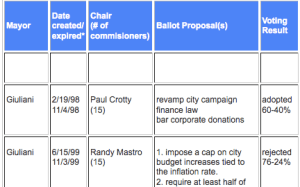
With the announcement of a 2010 charter commission coming (likely) any day now, it’s a useful reminder to see what’s come, or not come, from the city’s last few charter revision commissions. To that end, Gotham Gazette released today a very readable chart of the six charter revision commission proposals since the major revision in 1989.

Starting in 1998 under Giuliani, the chart provides: the sitting mayor, the dates each commission was created and expired, the name of the chair and number of commissioners, the ballot proposals and the voting result (adopted/rejected, %).

Not a comprehensive charter history education, for sure, but a handy resource.

What Did You Pay for Your Last Rental?

Just a brief note about City Hall’s announcement last week of its deal with Central Amusement International to develop 6.16 acres of land in Coney Island for two new amusement parks to be called “Luna Park at Coney Island” and the “Scream Zone.” Annual rent will be $100,000 for the first 10 years, with the city also expecting to receive “additional revenue derived from gross receipts from the amusement park.”

NYC’s Economic Development Corporation purchased this land in November, 2009 as part of a 6.9-acre, $95.6 million deal with Thor Equities—that’s $85.3 million prorated to the 6.16 acres being used for the parks.

Let’s do some math here: 43,560 square feet to an acre, times 6.16… about 270,000 square feet for the parks. $100,000 a year in rent divided by the square footage? That’s 37¢ per square foot, per year, the city’s charging CAI.

We’re all for Coney Island’s revitalization, and we’re firm believers in the importance of keeping NYC a world-class tourist destination, but we’d hope that City Hall could have cut a better deal for taxpayers than this one seems to be.

Comments from City Hall?

Charter Commission to be Named

Mayor Michael R. Bloomberg’s long-awaited New York City Charter Revision Commission is expected to be named on Tuesday, February 23, 2010. According to a highly-placed source, the commission will be chaired by CUNY Chancellor Matthew Goldstein.

Goldstein, a graduate of City College and former president of Baruch College, Adelphi University, and the Research Foundation of CUNY, was first mentioned as the leading 2010 charter chair candidate by Adam Lisberg, Daily News City Hall Bureau Chief, on February 9. Lisberg’s story cited some insiders’ concerns about Goldstein’s ability to remain free of Mayor Bloomberg’s control, while other sources dismissed this, predicting Goldstein’s independence.

As we’ve said before, a lot depends on who heads the commission’s staff as executive director. More to come after the mayor’s announcement.