Tag Archives: NY charter revision

Too Much Decentralization?

Pedro Espada Jr.

As our “About” entry indicates, in our other life we chair one of Brooklyn’s community boards. We’re believers in the utility of these 50-member local advisory bodies. We’ve seen them protect neighborhoods against City Hall excesses, assist elected officials when they needed to communicate with local residents, help agency people to coordinate local service delivery, and prevent wasteful municipal spending on projects that won’t work.

So our usual reaction when people from outside the community boards want to change the way boards operate is to ask whether they know what they’re talking about. We’re not completely sure that Huffington Post “writer, musician and New Yorker” Will Schwartz has the whole picture. Some of his assumptions about boards having “untrained, un-vetted leaders” and lacking “economists, public health officials, lawyers, hospital administrators, and other trained professionals” are without merit. But he knows enough about city government to understand that a recent charter revision proposal from controversial State Senator Pedro Espada is completely off the mark. Continue reading
DOE: A Gap in the City Charter

Adrienne Kivelson

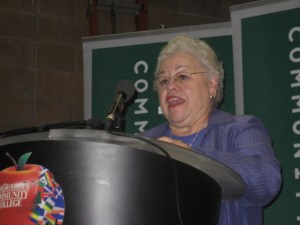
Arguably, the speaker who got the closest attention from the staff of the New York City Charter Revision Commission at Monday night’s public hearing in Queens was Adrienne Kivelson, City Affairs Chair of the League of Women Voters of the City of New York.

Ms. Kivelson identified a glaring gap in the City Charter: the document’s failure to recognize the Department of Education as a mayoral agency, despite the control over DOE the state legislature granted to the mayor in 2002, and renewed in 2009. Proposing that the commission “codify the Department of Education in the City Charter,” Ms. Kivelson called for the agency “to be subject to the same oversight and accountability imposed on every other Mayoral agency. Continue reading

NYC’s Economy: Charter Revision Can Help

“Wall Street Must Recover Before City Can Overcome Recession, Economists Say.”

That’s the headline over Patrick McGeehan’s NY Times article Wednesday about an interview with economists at the Federal Reserve Bank of New York. He repeated this message in a follow-up story on unemployment rates on Thursday.

What are the prospects for a Wall Street recovery? Not good, according to McGeehan’s sources at the Fed.

Quoting one of them, Fed regional economist Rae D. Rosen, McGeehan reports that “Wall Street still appears to be shrinking. The latest figures from the State Labor Department showed that the number of jobs in the city’s securities industry declined by about 2,000, or 1 percent, in February, while most other sectors were adding jobs.” Continue reading

Charter Revision: What the Mayor Really Wants

Michael Bloomberg

How does Mayor Michael Bloomberg view the goals of his 2010 charter revision commission? Celeste Katz, the new editor of the DN’s Daily Politics blog, answers this in her April 13th piece on the mayor’s changing stance on the future of the Public Advocate and the borough presidents. Katz quotes Bloomberg about the BPs:

“I for one have come to believe that the Borough Presidents really do provide value added. I don’t agree with everything everyone does but on balance the Borough Presidents provide, at a local level, working with community boards and working with the City Council people, a valuable service and whether you could do it more effectively or not, whether they should be allowed to do A, B or C, those are the details.” Continue reading

The Times Has Spoken

Anthony Crowell, John Banks, Matthew Goldstein

You can be pretty sure that Saturday’s NY Times editorial condemning this year’s abbreviated charter revision timetable got the mayor’s attention.

The editorial directly criticized Mayor Michael Bloomberg’s plan to rush charter revision in order to advance a couple of initiatives he’s especially interested in: term limits and non-partisan elections.

At first glance, these seemingly simple changes to NYC’s political process look like things voters could handle without long analysis and discussion. But political changes, even the simplest ones, can have unintended consequences. Continue reading

Press Coverage of Charter Revision Hearing

NYC Charter Revision Commission

Next-day coverage of the first public hearing of the 2010 NYC Charter Revision Commission was less than global. The most analytic piece may have appeared on silive, the news blog of the Staten Island Advance.

“Surprise sprung by Charter chair; L.I. attorney named to direct panel and Staten Island secession vet tabbed as research director,” was the silive lede. The story, by Peter N. Spencer, discussed the implications of charter chairman Matthew Goldstein’s choice of executive director Lorna B. Goodman and research director Joseph P. Viteritti for key commission staff roles. Continue reading

Charter Panel Hears Pitch for Non-partisan Elections

Carl Paladino at NYC Charter Revision Commission Hearing 4/6/10

A surprise visit by Carl Paladino, millionaire Buffalo developer and newly-announced candidate for Governor, provided some media candy at Tuesday evening’s NYC Charter Revision Commission public hearing at the CUNY Graduate Center in Manhattan. Paladino’s open disdain for New York’s partisan electoral politics brought passion to the dominant message voiced in Tuesday’s public testimony: Make NYC elections non-partisan. Continue reading

Charter Revision: How to Reduce Conflicts of Interest

Patricia E. Harris

Writing in The NY Times City Room Blog, Michael Barbaro calls attention to Mayor Michael R. Bloomberg’s announcement naming “Patricia E. Harris, the second-most powerful official at City Hall, to be the chief executive and chairwoman of the multibillion-dollar Bloomberg Family Foundation.”

Barbaro notes that “in 2008, Ms. Harris and a City Hall aide, Allison Jaffin, obtained a waiver from the city’s Conflicts of Interest Board to work at the foundation while keeping her job at City Hall, arguing that her work was voluntary and involved minimal use of public resources. At the time, however, she held the title of president.”

Barbaro’s story has drawn dozens of comments from readers, most of them critical of Mayor Bloomberg’s use of his vast personal wealth to influence city policy. Continue reading

Charter Revision Commission Announces April Public Hearing Schedule

The New York City Charter Revision Commission has issued its schedule of public hearings for April, 2010. One hearing is scheduled in each borough.

The first hearing will be held on Tuesday, April 6, at the CUNY Graduate Center, 365 Fifth Avenue, in the Proshansky Auditorium. This hearing, like all the others except for a 4 p.m. hearing in Brooklyn on April 20th, is scheduled to start at 6 p.m.

The full public hearing calendar can be found here.

NYC’s Forgotten Borough

To most Manhattanites, Staten Island may as well be New Jersey (geographers and Staten Islanders feel the same way). Once you step off the ferry at St. George Terminal, you’re in a different world: a revolutionary war fort, mile after mile of low-rise garden apartments, Victorian frame houses on winding streets, and wooded hillsides studded with stone and brick mansions.

New Yorkers who view Staten Island only from the S.I. Expressway and the West Shore Expressway don’t see the island’s vast industrial tracts on one shore, its beautiful public beach on another, the endless strip mall that is Hylan Boulevard, and the island’s golf courses, forests, and pre-Verrazano enclaves, which still hint at their rural origins. It just ain’t the same city as high-rise Manhattan.

That’s the message that Tom Wrobleski, political editor for the Staten Island Advance, sends to the 2010 NYC Charter Revision Commission. With just one Islander on the 15-member commission, Wrobelski doubts that Staten Island’s small-town distinctiveness can be adequately considered when the commission revises NYC’s government this year. To Wrobleski, the city’s rules in Manhattan and Staten Island need to be different. And many community leaders from Brooklyn and Queens feel the same way about their own boroughs. Continue reading