Category Archives: 2010 NYC Charter Revision

Government 311: How to Improve Complaint Submission

It’s not the first time that 311 has been used to harass neighbors, but it may be the most egregious. Jim Dwyer, writing in the Metropolitan Section of Sunday’s NY Times, tells of a rash of phony 311 complaints that, Dwyer says, “has put thousands of homeowners in Queens under a state of bureaucratic siege.”

“From September to December, more than 3,000 complaints of illegal [residential] conversions were filed in three Queens neighborhoods — Whitestone, Flushing, and Malba.” The result: Buildings department inspectors repeatedly seeking entry into homes maliciously identified by anonymous complainants. Continue reading
The Bloomberg/Citizens Union Charter Agenda

Mayor Bloomberg’s 2010 charter revision partnership with the Citizens Union showed its face Monday in the form of a comprehensive charter overview by CU panelist Douglas Muzzio, a professor at Baruch College. Here’s some of what Muzzio wrote, with our translations in italics:

Describing the current city charter, Muzzio called it “a large document (currently 356 pages), packed with organizational minutiae, much of which belongs in the Administrative Code.” The Bloomberg commission — with the help of the Citizens Union — will call for “streamlining” the charter by shifting some of its provisions to the Administrative Code. This will make it easier for the mayor and the Council to change those provisions later on, without the public scrutiny that would occur if they remained in the charter.

Continue reading

Charter Revision: Whose Rules?

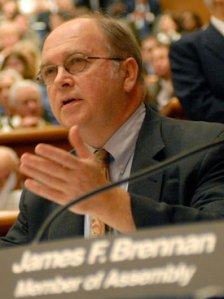
Frustration grew to a boil near the end of a March 5 public hearing by the NYS Assembly’s Standing Committee on Cities at 250 Broadway. The committee, chaired by Assemblyman James Brennan (44AD), was hearing comment on proposed bills to amend the State’s Municipal Home Rule Law, which governs how New York’s cities may revise their charters.
Just two days earlier, Mayor Michael Bloomberg had announced the creation of a 2010 charter revision commission for New York City. To the surprise of many, the Bloomberg announcement singled out the Citizens Union, a century-old independent “good-government” reform group, to partner with the charter commission to improve public outreach. Continue reading

Why Charter Revision Matters: Our Core Principles

Some of our readers may wonder why we repeatedly worry about giving the mayor any additional powers. It’s because we believe that our current system of government tends to select city-wide leaders who support the interests of Manhattan’s finance and real estate industries — to the detriment of other boroughs and other industries. As important as finance and real estate are for the city’s financial solvency (right now, they’re still crucial), they don’t tend to create middle-income jobs, which can leave us in a vulnerable place in an economic downturn, as in 2008-2009. Simply put, we’ve placed too many of our eggs in one or two baskets. Continue reading

Mayor Finally Names 2010 Charter Revision Commission

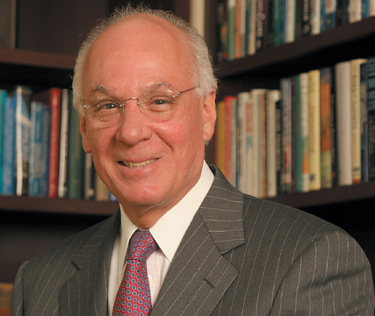
Matthew Goldstein

Mayor Michael R. Bloomberg finally named CUNY Chancellor Matthew Goldstein to chair his 2010 charter revision commission. Along with Goldstein, the mayor’s press release identified 14 other commission members.

Two of them can be expected to be particularly sensitive to the interests of NYC’s community boards: Anthony Perez Cassino, an attorney who served as Chairman of Bronx Community Board 8 from 2004-2008, and Carlo Scissura, who currently serves as Chief of Staff to Brooklyn Borough President Marty Markowitz. Continue reading

Charter Revision: No Lauder?

Elizabeth Benjamin reports that billionaire businessman Ron Lauder, principal sponsor of the 1990s referendums that restricted NYC elected officials to two 4-year terms, has declined to serve on Mayor Michael Bloomberg’s anticipated 2010 charter revision commission. If confirmed, Lauder’s withdrawal may mean that he expects the Bloomberg commission to seek to ratify last year’s City Council legislation that extended the limits to three consecutive terms—or maybe even to try to eliminate term limits entirely.

Government 101, Lesson 1: Why Can’t the Streets Be Smoother?

Sometimes, the best ideas come while driving in heavy traffic. Although we don’t talk or text while behind the wheel, we do tend to obsess about city government. We also do that in other inappropriate situations.

Our latest episode happened while driving up Brooklyn’s Coney Island Avenue. Our tires kept on banging into one manhole depression after another. The 5-minute ride felt as if we were on an IED-pocked road in Afghanistan, not a major thoroughfare in America’s largest and most vibrant city. “Why can’t the city even pave the streets right?” we asked.

But, of course, we already knew the answer: Coney Island Avenue had been paved by a low-bid contractor, working under the oversight of private engineering consultants. They, in turn, had been supervised by civil servants who may have lacked the tools to impose useful sanctions if either the consultant or the contractor screwed up. Could efficiency improvements — which Mayor Bloomberg’s 2010 charter revision commission may try to implement — solve this? Continue reading

A Chart of NYC Charters Past

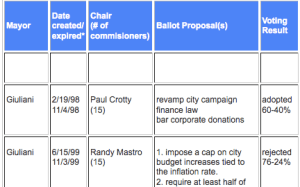
With the announcement of a 2010 charter commission coming (likely) any day now, it’s a useful reminder to see what’s come, or not come, from the city’s last few charter revision commissions. To that end, Gotham Gazette released today a very readable chart of the six charter revision commission proposals since the major revision in 1989.

Starting in 1998 under Giuliani, the chart provides: the sitting mayor, the dates each commission was created and expired, the name of the chair and number of commissioners, the ballot proposals and the voting result (adopted/rejected, %).

Not a comprehensive charter history education, for sure, but a handy resource.

Charter Commission to be Named

Mayor Michael R. Bloomberg’s long-awaited New York City Charter Revision Commission is expected to be named on Tuesday, February 23, 2010. According to a highly-placed source, the commission will be chaired by CUNY Chancellor Matthew Goldstein.

Goldstein, a graduate of City College and former president of Baruch College, Adelphi University, and the Research Foundation of CUNY, was first mentioned as the leading 2010 charter chair candidate by Adam Lisberg, Daily News City Hall Bureau Chief, on February 9. Lisberg’s story cited some insiders’ concerns about Goldstein’s ability to remain free of Mayor Bloomberg’s control, while other sources dismissed this, predicting Goldstein’s independence.

As we’ve said before, a lot depends on who heads the commission’s staff as executive director. More to come after the mayor’s announcement.

In Staten Island, Hope Stays Alive

Tom Wrobleski reports on Staten Island’s push for full representation on Mayor Bloomberg’s anticipated 2010 charter revision commission.  Wrobleski’s piece in the Advance features leaders who focus on whether Staten Island will get enough seats on the commission to ensure that it will “look at shifting some decision-making away from City Hall and giving the borough more local control, especially over land-use and traffic issues.” Continue reading