Tag Archives: Michael Bloomberg

Charter Revision: Whose Rules?

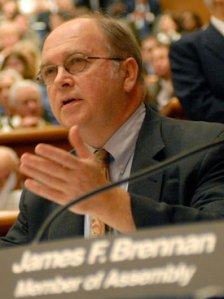
Frustration grew to a boil near the end of a March 5 public hearing by the NYS Assembly’s Standing Committee on Cities at 250 Broadway. The committee, chaired by Assemblyman James Brennan (44AD), was hearing comment on proposed bills to amend the State’s Municipal Home Rule Law, which governs how New York’s cities may revise their charters.

Just two days earlier, Mayor Michael Bloomberg had announced the creation of a 2010 charter revision commission for New York City. To the surprise of many, the Bloomberg announcement singled out the Citizens Union, a century-old independent “good-government” reform group, to partner with the charter commission to improve public outreach. Continue reading
Why Charter Revision Matters: Our Core Principles

Some of our readers may wonder why we repeatedly worry about giving the mayor any additional powers. It’s because we believe that our current system of government tends to select city-wide leaders who support the interests of Manhattan’s finance and real estate industries — to the detriment of other boroughs and other industries. As important as finance and real estate are for the city’s financial solvency (right now, they’re still crucial), they don’t tend to create middle-income jobs, which can leave us in a vulnerable place in an economic downturn, as in 2008-2009. Simply put, we’ve placed too many of our eggs in one or two baskets. Continue reading

Mayor Finally Names 2010 Charter Revision Commission

Matthew Goldstein

Mayor Michael R. Bloomberg finally named CUNY Chancellor Matthew Goldstein to chair his 2010 charter revision commission. Along with Goldstein, the mayor’s press release identified 14 other commission members.

Two of them can be expected to be particularly sensitive to the interests of NYC’s community boards: Anthony Perez Cassino, an attorney who served as Chairman of Bronx Community Board 8 from 2004-2008, and Carlo Scissura, who currently serves as Chief of Staff to Brooklyn Borough President Marty Markowitz. Continue reading

Government 101, Lesson 2: Why Does NYC Have So Many Traffic Lights?

Well, actually, only about 12,000 of NYC’s 43,000 intersections are “signalized.” The borough with the most traffic lights is Brooklyn, with over 4,000. One report has it that the first red-green light in NYC was installed in 1930.

By the Giuliani administration, the numbers were in the thousands, and the city’s Department of Transportation needed 34 months to evaluate whether an intersection needed one. Giuliani saw the lights as an easy way to curry favor with constituents, so he instructed Transportation Commissioner Christopher Lynn to eliminate a 600-light backlog and cut the study time. Lynn reduced the study time to 12 weeks. During his regime, the number of traffic lights installed went from 56 in 1995 to 169 in 1996, and to a a planned 222 in the first five months of 1997. By early 1997, the city’s traffic lights totaled 10,687. By January, 2006, after Michael Bloomberg had been in office for four years, the number had increased to 11,871. Continue reading

Charter Revision: No Lauder?

Elizabeth Benjamin reports that billionaire businessman Ron Lauder, principal sponsor of the 1990s referendums that restricted NYC elected officials to two 4-year terms, has declined to serve on Mayor Michael Bloomberg’s anticipated 2010 charter revision commission. If confirmed, Lauder’s withdrawal may mean that he expects the Bloomberg commission to seek to ratify last year’s City Council legislation that extended the limits to three consecutive terms—or maybe even to try to eliminate term limits entirely.

Charter Schools Chief Tells It (sort of) Like It Is

Michael Duffy photo: the Lo-Down

In a revealing interview with NYC Department of Education charter schools head Michael Duffy, Ed Litvak of the Lower East Side news blog The Lo-Down questions Duffy about how the NYCDOE used a recent public hearing on the proposed expansion of a Lower East Side charter school. Duffy’s response won’t surprise anyone who has sat through a charter school hearing:

“It definitely provides a forum for people to speak out, and I think that’s a good thing. It helps to get good information out there… I think, for my part, in a couple of hours of comments, I didn’t hear anything new from the public that wasn’t already known prior to the start of the hearing. I know it’s important that people have a chance to speak their mind, but I don’t think there’s anything that wasn’t known to the Department prior to the proposal…” Continue reading

In Staten Island, Hope Stays Alive

Tom Wrobleski reports on Staten Island’s push for full representation on Mayor Bloomberg’s anticipated 2010 charter revision commission.  Wrobleski’s piece in the Advance features leaders who focus on whether Staten Island will get enough seats on the commission to ensure that it will “look at shifting some decision-making away from City Hall and giving the borough more local control, especially over land-use and traffic issues.” Continue reading

NY Post: Keep the Council Kosher!

We try not to miss  Queens Crap, which continues to be entertaining, timely, and informative, even though it lacks some of the anti-Bloomberg focus it had before its favored candidate for mayor, Tony Avella, lost his bid last fall.

But even this popular and populist website, which describes itself as “focused on the overdevelopment and ‘tweeding’ of the borough of Queens in the City of New York,” occasionally fails to read between the lines.  We were surprised when those lines had appeared in the pro-Bloomberg NY Post.

When a Post editorial tried to link instances of corruption by individual legislators with City Council Speaker Christine Quinn’s use of “pork” to keep members in line, Queens Crap asked about Quinn, “Will she really reform the council?” The Crapper seemed to forget who would benefit most if the Post got its wish and the Council suddenly went Kosher.

Eliminate “pork” and “lulus,” the extra compensation that the Speaker hands out to loyal Council members for chairing committees, and you’ll end up with a Speaker who is less able to unite her members when it comes time for the Council to say “no” to something the mayor wants to do. What would happen to overdevelopment and “tweeding” then?

Term Limits: The Rub with re-Democratizing NYC

NY City Hall

One of the perquisites of being Mayor of NYC is that you get to decide who in the city can make millions of dollars. Officially, the path to city deals—for concessions, leases and major development projects—goes through any one of a number of committees, boards and commissions that dole out the city’s money, seemingly (partially) independent of the mayor. Yet, unofficially, or at least a level or two below the surface of public perception, the mayor’s fingerprints are all over the process. For all of these decision-making groups have two things in common: They were established through the 1989 charter revision, and the mayor appoints a majority of their members. Changing this with a new charter revision will be no simple task. Continue reading

Keeping Our Eyes on the Prize

Several days ago, CityPragmatist observed that former Bloomberg charter revision commission chair Ester Fuchs seemed ideally positioned to play a role at this year’s charter revision commission. A day later, the Daily News floated the name of CUNY Chancellor Matthew Goldstein as Bloomberg’s pick for 2010 chair. The next day, silive.com, the news blog of the Staten Island Advance, floated the name of Billionaire Ron Lauder as Bloomberg’s pick. Then, someone called to our attention yet another chair designation: Anthony Crowell, a Bloomberg senior counselor, reported by Edward-Isaac Dovere of City Hall News. What’s going on here? Continue reading