Efficiency! is Theme of Charter Hearing

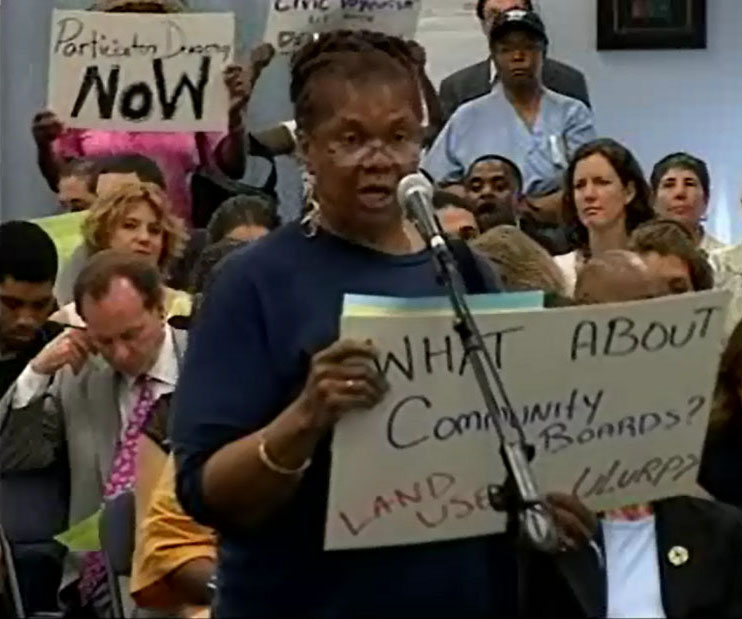
NYC Charter Revision: If anything, Matthew Goldstein’s treatment of a group of protesters at Monday’s charter revision commission hearing was efficient. When the protesters interrupted the Harlem State Office Building session by chanting “Show me what democracy looks like. This is what democracy looks like,” Goldstein didn’t even blink.

Apparently well-schooled in street theatre, the CUNY Chancellor waited for the protesters to finish their call-and-response and deliver their statements demanding a more democratic process before he returned to the business at hand. He didn’t waste a Joule of energy.

Goldstein’s invited guests, who also waited while the middle-aged protesters did their thing, were 2005 charter commission chair Ester R. Fuchs, currently a fellow at the Partnership for New York City, her 2005 executive director, Terri Matthews, current Bloomberg deputy mayor for legal affairs Carol Robles-Roman, and David B. Goldin, the mayor’s Administrative Justice Coordinator.

Their task was to educate the 2010 commission about two “efficiency” initiatives contained in its preliminary staff report for possible ballot inclusion this November. Continue reading

What’s the Deal at DCAS?

Mike Bloomberg's Press Conference

Martha K. Hirst has headed up DCAS, the city agency responsible for leasing office space, since Michael Bloomberg took office.  So when one of our readers suggested we look at a recent Daily News article that said that new Bloomberg deputy mayor and efficiency expert Stephen Goldsmith had identified 10,000 unused office spaces rented by City Hall, and was proposing getting rid of them to save bucks, we eventually Googled on Martha’s name.

We discovered that Hirst was out, replaced by Acting Commissioner Donald P. Brosen, with only a brief announcement by City Hall on July 14. Continue reading

Stephen Goldsmith, Unexpurgated

Stephen Goldsmith at Crain's Breakfast Forum

Contrast the two available videos that show deputy mayor Stephen Goldsmith’s response at the July 20 Crain’s Breakfast Forum to a question by Erik Engquist. Engquist asked Goldsmith what City Hall plans to do to close those fire houses that, according to Engquist, “don’t contribute to safety.”

We watched both versions: a tightly-edited professional video on the Crain’s New York Business website, and a longer, hand-held, and presumably unedited video, posted by reader Louis Flores. It showed that Crain’s skips some of the more controversial issues Goldsmith touched on. Continue reading

Don’t Worry, Be Happy!

The Recession is over!

So says the Fed, as reported by the New York Times.

Now, doesn’t that make you feel better?

Have a great weekend!

Surprise: Charter Commission to Give More Power to the Mayor

NYC Charter Revision: They didn’t say it in so many words, but the 2010 Charter Revision Commission members are heading in the direction of giving the mayor even more power than Mike Bloomberg has today — at the expense of the City Council and government transparency.

How: by creating a new “reporting commission,” putatively to get rid of unnecessary advisory bodies and trim the number of reports the mayor has to submit each year. Some of those reports are not used. But the charter revision commission would give the new reporting commission the power to review (and reject?) any future City Council decision to “extend or enhance” a report the mayor already provides.

Because a majority of the members of the reporting commission would be appointed by — you guessed it — the mayor, he would be able to frustrate the Council if it wants to ask for additional information from his agencies: a loss for the Council and transparency, and a gain for him. Continue reading

Citizens Union: NYC Needs Top-Two Elections

Citizens Union Speakers

NYC Charter Revision: Non-partisan primary elections — or, as the Citizens Union has re-labeled them, “top-two elections” — dominated Monday’s charter revision commission session at Brooklyn College.

The CU team proposing top-two included chairman Peter Sherwin, Executive Director Dick Dadey, senior staff members Alex Camarda and a silent Rachael Fauss, and the disembodied voice of CU Foundation board member John P. Avlon, who was unable to appear in person.

So effectively counterbalanced was CU’s top-two advocacy by the opposition from floor speakers that the evening felt scripted, almost as if some political strategist had said “we’ll satisfy CU that we’re listening to them, but we’ll give enough opponents a chance to speak that CU will realize that putting non-partisan elections on the ballot this year would fail. And then the mayor won’t owe anything to them or to the Independence Party.” Continue reading

“Good Government” Comes to Flatbush

The Citizens Union, NYC’s oldest “good government” group and “public partner” of the 2010 NYC Charter Revision Commission, will get a chance to present its recommendations to the commission and the public on Monday, July 19, at 6:00 PM at Gershwin Theater at Brooklyn College. The session will be webcast.

The Citizens Union already has conveyed its 49 charter recommendations in a 114-page report entitled “Increasing Avenues for Participation in Governing and Elections in New York City,” released on June 30. Monday’s session will set aside time for discussion of these recommendations by Citizens Union Executive Director Dick Dadey and CU senior staff members Alex Camarda and Rachael Fauss, and questions by commission members. Continue reading

NY Media Ignore Major Charter School Study

For reasons we can’t explain, a June 29, 2010 study that showed “on average, charter schools had no significant impacts on student achievement in math and reading” drew zero attention from New York media — including education blogs.

The 15-state, 36-school study, funded by the U.S. Department of Education and conducted by the prestigious Princeton-based Mathematica Policy Research, Inc., was announced one day after the New York State Senate passed legislation raising the state’s charter school cap from 200 to 460 — a result of a months-long lobbying campaign by charter advocates.

Until the legislature’s approval, New Yorkers had been bombarded by TV commercials, print ads, and editorials and op-ed pieces in the Daily News, the Post, and the NY Times — all urging legislators to lift the charter cap to improve New York’s chance to win Federal funding in Round 2 of Race to the Top, the Obama administration’s school reform incentive program.

But critics suggested that the RttT eligibility goal was just cover for a well-funded opinion campaign aimed at pressuring legislators to increase the number of charter schools. Ultimately, the legislation incorporated several limitations, including a stipulation that new charters may not be operated by for-profit companies. Continue reading

Scissura: Practice What You Preach

2010 NYC Charter Revision Commission

The 2010 NYC Charter Revision Commission spent much of its July 12 meeting agonizing over ways to restore the public’s faith in government and increase voter participation. It did not acknowledge that voter apathy may stem from the public’s resignation that billionaires will continue to control the Mayor’s office, and that selection of City Council members may make little difference in shaping City Hall’s major decisions.

The webcast meeting had been convened to discuss the commission staff’s July 9 preliminary report. But as quickly as the staff’s proposal for instant run-off voting — IRV — appeared on the pages of that report, it got jettisoned when chairman Matthew Goldstein’s colleagues complained that they never had discussed it. Continue reading

Charter Commission Reveals Ballot Issues

Lorna B. Goodman

Mayor Michael Bloomberg will like what his charter revision commission plans to place on November’s ballot.

After a whirlwind round of 13 public hearings, meetings and panel discussions, and consideration of testimony from hundreds of individuals and groups, the 2010 NYC Charter Revision Commission has narrowed its ballot agenda to include term limits, which satisfies Bloomberg’s 2008 commitment to billionaire term limits advocate Ron Lauder, along with several other changes that could subtly shift power towards Bloomberg’s end of City Hall.

The selected issues are laid out in a July 9 staff report, which the commission will discuss at its 6:00 PM July 12 public meeting at the Surrogate’s Courthouse in Manhattan. Continue reading